When it comes to understanding price action, forex candlestick patterns are a trader’s best friend. These patterns give you a visual snapshot of market sentiment—whether buyers or sellers are in control—and can help you spot potential reversals or trend continuations. From the classic doji to the powerful engulfing pattern, each candle tells a story that can sharpen your entry and exit decisions.
Whether you’re just starting out in forex trading or trying to improve your strategy, understanding candlestick patterns can dramatically boost your trading decisions. And when you combine these patterns with smart tools like a lot size calculator and a risk-to-reward calculator, you’ll not only trade smarter—you’ll trade with confidence.
What Are Forex Candlestick Patterns?
Candlesticks are a way to visually represent price movements in a specific time frame—could be 1 minute, 1 hour, or even a day. Each candlestick shows four important points: the opening price, closing price, the highest price, and the lowest price during that period.
When you start stringing these candles together, you begin to notice recurring patterns—like a “Doji,” “Engulfing,” or “Hammer.” These forex candlestick patterns give insights into whether bulls or bears are winning and can signal potential market reversals or continuation.
In short, learning these patterns is like learning the language of the market.
Popular Candlestick Patterns Every Forex Trader Should Know
Here are some go-to patterns that every trader should have in their toolkit:
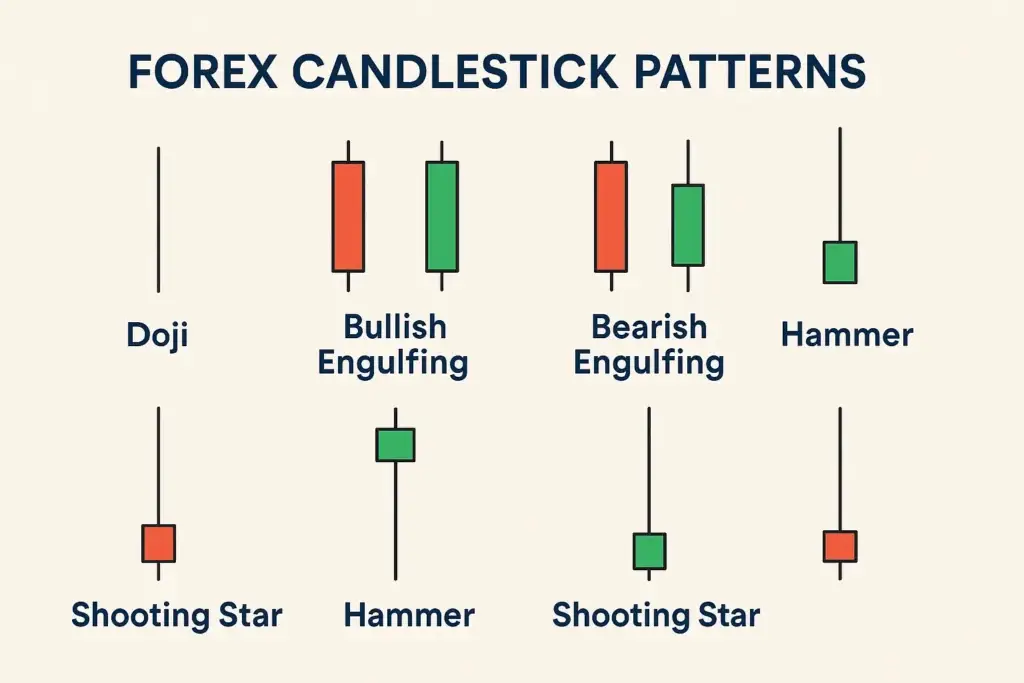
Doji: When the opening and closing prices are nearly the same. It signals market indecision, which can hint at a possible reversal.
Bullish Engulfing: A small red candle followed by a large green candle that fully “engulfs” the red one. This often signals a potential bullish reversal.
Bearish Engulfing: Opposite of bullish engulfing. Can signal an upcoming downward move.
Hammer: A small body with a long lower wick. Appears at the bottom of a downtrend and can be a bullish reversal signal.
Shooting Star: Looks like an upside-down hammer and usually appears at the top of an uptrend. It’s often seen as a bearish reversal sign.
These are just the beginning. There are dozens of patterns, but focusing on a handful of reliable ones will go a long way in improving your chart-reading skills.
Why Forex Candlestick Patterns Matter
You might be wondering—can’t I just use indicators or expert advisors (EAs)? Sure, indicators are helpful, but they often lag behind price action. Candlestick patterns, on the other hand, offer real-time insight into market sentiment. They can tell you:
When a trend is losing strength
When a reversal might be around the corner
Whether a breakout is real or fake
How strong the current momentum is
The best traders often use candlestick patterns as part of a broader strategy, combining them with support/resistance zones, trendlines, and risk management tools.
Risk Management: The Unsung Hero of Trading
Even with the best candlestick pattern setups, no trade is ever 100% guaranteed. That’s why risk management is the backbone of long-term success. This is where tools like a lot size calculator and a risk-to-reward calculator become essential.
Lot Size Calculator: This helps you determine how many lots (or units) to trade based on your account size, risk tolerance, and stop loss. Without it, you’re basically gambling with your position size.
Risk-to-Reward Calculator: Before entering a trade, it’s smart to know whether the potential reward justifies the risk. A good rule of thumb is aiming for at least a 1:2 or 1:3 risk-to-reward ratio. This calculator takes the guesswork out of the equation.
Imagine spotting a perfect bullish engulfing pattern, but placing a huge trade that goes wrong—just one bad move can blow up your account. But with these calculators, you’ll know exactly what you’re risking and whether it’s worth it.
How to Practice Reading Candlestick Patterns
Use a Demo Account: Start practicing on a risk-free demo platform. Focus on identifying key patterns and how they behave near support/resistance areas.
Replay Historical Charts: Use charting platforms like TradingView to go back in time and study how candlestick patterns played out in different market conditions.
Journal Your Trades: Keep track of which patterns you used, what the outcome was, and what you learned.
Combine With Other Tools: Use moving averages, RSI, or Fibonacci levels with candlestick patterns to confirm your analysis.
Final Thoughts
Learning to read forex candlestick patterns isn’t just for technical analysts or chart nerds—it’s for anyone who wants to make smarter, more confident trades. These patterns give you a deeper understanding of what’s really happening in the market, often before an indicator can catch up.
And when you pair candlestick knowledge with essential tools like a lot size calculator and risk-to-reward calculator, you bring logic and discipline into your trading. That’s what separates the gamblers from the pros.
So, next time you pull up a forex chart, don’t just look at it—read it. The candlesticks are already telling you a story. You just need to learn the language.